
How do we solve the problems facing society in the 5G era?
Hideo Takasaki, President of Nitto Denko Corporation
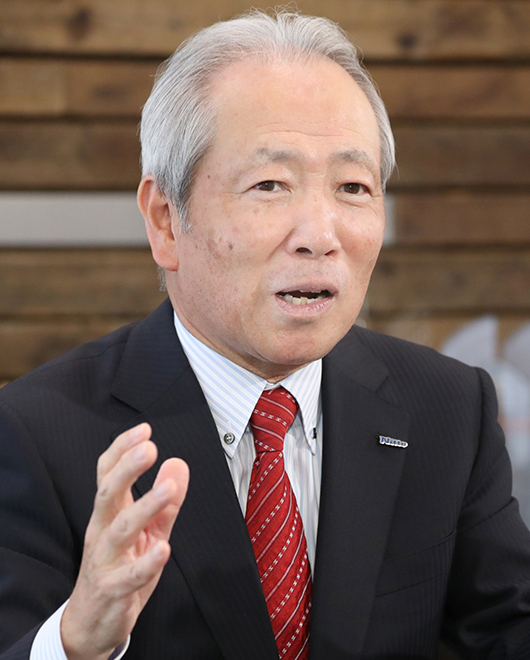
Services utilizing 5G, the next-generation communications standard, will begin operating in Japan next year. If large capacity of data can be sent instantly, we may propel revolution in a wide range of fields, including telemedicine, ultra-high-definition broadcasting, and autonomous vehicles. Nitto Denko marks 101 years since its founding. Looking ahead to the next 100 years, we would like to contribute to the society first through technologies that support the 5G era.
One of these technologies is plastic optical fiber material. When we talk about 5G technology, wireless communication base stations come to mind. However, for transmitting the large capacity of data in the 5G era, it is necessary a significant amount of optical fiber in offices and homes as well as at data centers.
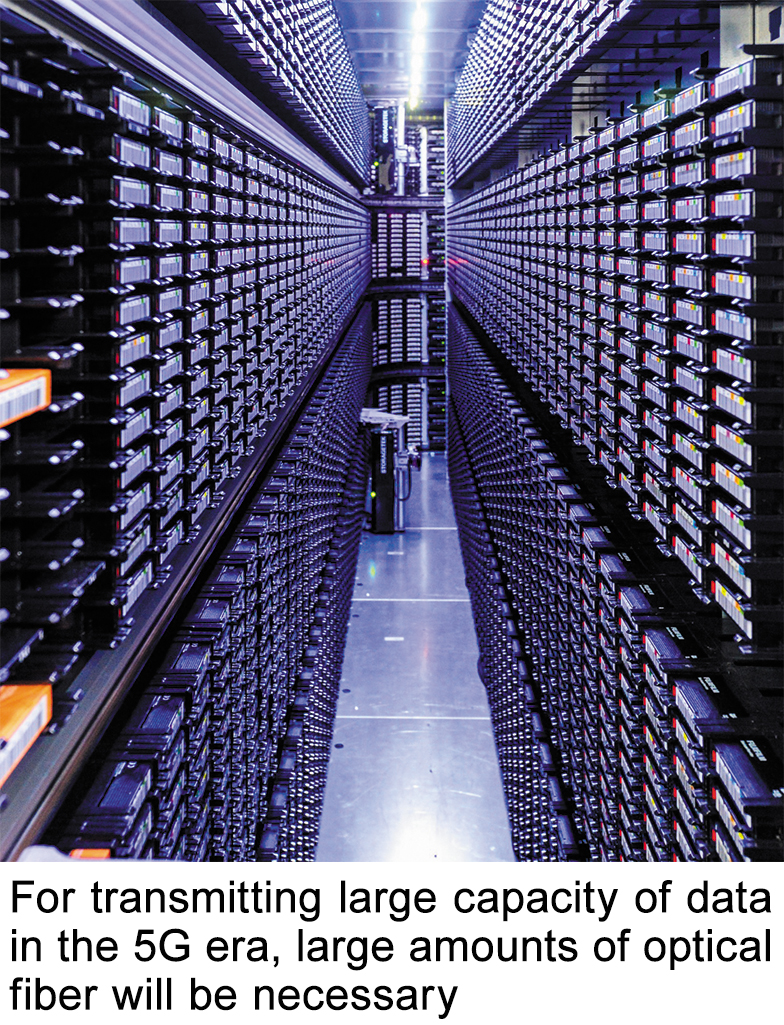
Glass materials are well suited for long-distance optical communication such as submarine cables. On the other hand, plastic fiber, which excels in the point of noiseless and flexibility, is suitable for the short distances seen in indoor wiring. Having a possibility of wide-ranging applications, we have received many business inquiries about our plastic optical fiber.
Connectors that convert light and electrical signals and low permittivity substrates are also important with 5G. Since Nitto Denko originally began in insulation technology, I believe we can support and contribute to the development of 5G-related infrastructure.
Three years ago, Nitto Denko established “inovas”, a research and development facility in Ibaraki, Osaka in order to develop new technologies. The name of the facility combines the words “innovation” and “nova”(Latin for “new star”). This facility aims to promote co-creation—open innovation—with business customers, universities and others, and aims to provide human resource development for employees, as well.
“inovas” is also used as the site for internships. In the internship program, we have those internship students try to propose new businesses under the theme of “How do we solve the various problems facing society?”
I recently asked the interns about the solutions of social problems in Vietnam. In order to propose our new businesses that can solve the regionally unique problems such as salt damage and health damage caused by the mold due to the humidity, it is necessary to study carefully both the local conditions and the technologies owned by Nitto Denko. Through the program, we provide a simulation experience of our marketing strategy “Sanshin activities” ※ which has been continued over 50 years.
※Nitto Denko's unique marketing activities through which explore “new application” and develop “new products”, thereby creating “new demands”, which grow into new markets.(Sanshin means these 3 “new”s.)
Now, I would like to ask readers a question today. 5G—which offers ultra-high speeds, simultaneous multiple connections, and low latency—will become a tool that can solve various problems in the society. Accordingly, the medical and control technologies will also no doubt change the world in significant ways. In this 5G era, what kinds of social problems should be solved and how? I look forward to hearing lots of ideas from you all.
【From the Editorial Committee】
With advances in new technological innovations such as artificial intelligence (AI) and robots, the next-generation communications standard 5G is expected to become the infrastructure to support these technologies. 5G will allow for speeds 100 times faster than current mobile communication services, simultaneous connections with large numbers of devices, and the communication of information without delays.
The expansion of 5G is expected to drive digital transformations that will greatly change existing business models. If Japan—a developed country facing unique challenges— solves problems facing society in medical care, agriculture, and other various fields using 5G technology, there is no doubt this will become a new strength for Japan.
5G wireless technology is being led by telecommunications equipment manufacturers in Europe, China, and so on. However, when it comes to technologies of optical fiber networks that support 5G, Japan has a slight advantage. And if plastic optical fiber developed by Nitto Denko is utilized, Japan will be able to support the global 5G market.
(Waichi Sekiguchi, Nikkei staff writer)
“Vision of the Future” is a section that Nikkei Inc. creates through close consultations with our readers on various challenges. The latest issue focuses on ideas that can change the world. We invite everyone to offer suggestions.
Top executives of Japan's leading companies will select some of the most promising submissions.