

What do you want to visualize? And what kind of sensors would you use to accomplish that?
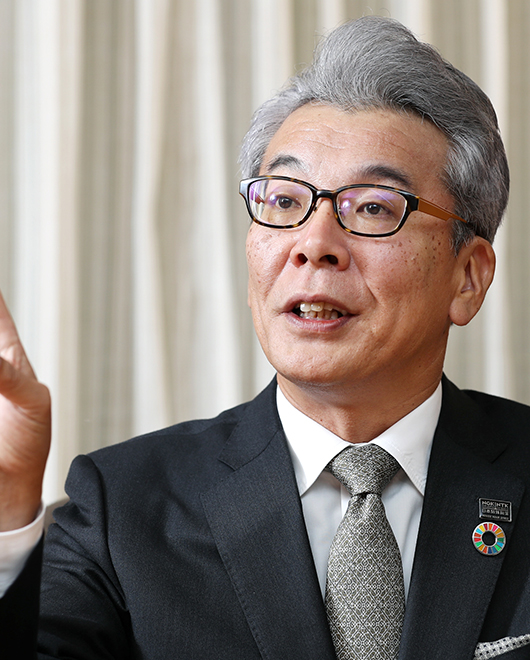
Takeshi Kawai, President & COO of NGK Spark Plug Co., Ltd.
Do our readers have a sixth sense? Humans have the five senses of vision, hearing, touch, taste, and smell. Abilities to sense that go beyond these are considered a sixth sense. What would you want to know if you had a sixth sense?
I ask because NGK Spark Plug Co., Ltd. is a company that also makes sensors that can detect things humans cannot see. Our main products are spark plugs that are used in the engines that power cars. But we also make sensors that detect the concentration of oxygen and nitrogen oxides contained in the exhaust gas during the combustion of gasoline. These measure and quantify gases that are invisible.
Our company has been working on ceramics for many years. Ceramic elements are also used in our oxygen sensors and other products. The exhaust gas from an engine can exceed 1,000 degrees Celsius. If a sensor cannot function in harsh and particular environments, it will not be possible to burn gasoline efficiently. Responding to emission standards around the world that are becoming more stringent every year, we have contributed to the improvement of environmental issues.
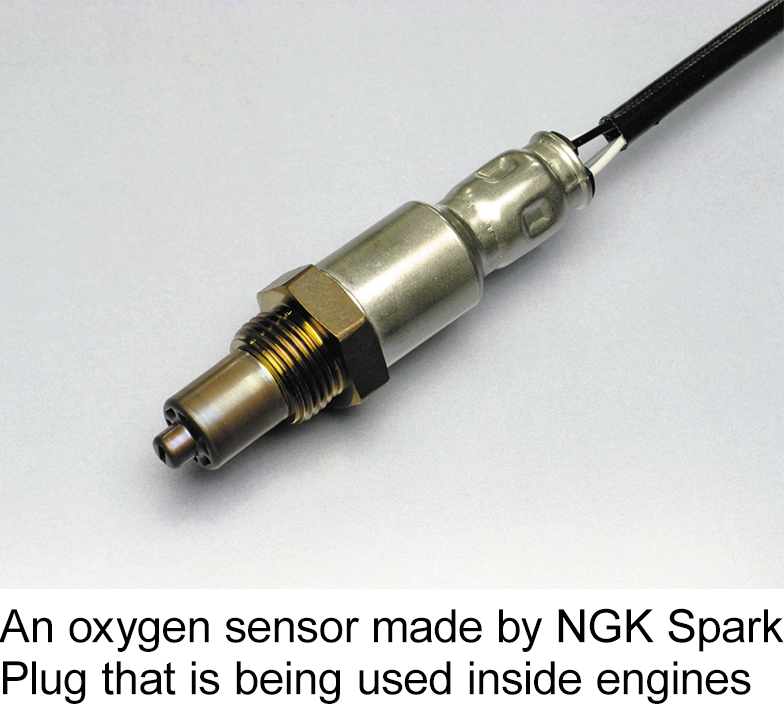
Various sensors around the world are making life better for us by visualizing and quantifying various things. We make sensors with unique functions that are used in particular places.
This is where I have a question for you, the readers. What do you want to visualize? And what kind of sensors would you use to accomplish that?
Sensor technologies developed to be used inside engines are now beginning to be used in many other areas. For example, we are considering using a water quality sensor in partnership with a startup for the onshore aquaculture of fish. We think such sensors can contribute to water quality management by measuring the concentration of ammonia in the water and water temperatures and uploading these to the cloud.
In addition, exhalation sensors that measure the concentration of nitric oxide contained in human breath are also used as an asthma management indicator. We are also working on research and development of devices that detect brain blood flow. While the field of medicine and the automotive industry may seem worlds apart, we have made artificial ceramic bones and entered the field of medicine with the belief that we can contribute further.
These fields are hugely compatible in some ways. This is because sensors help us understand each other's feelings and ways of thinking. Understanding other people's feelings can lead to a more peaceful society.
The Morimura Group—made up of Noritake Co., Limited, TOTO Ltd., NGK Insulators, Ltd. and ourselves—will bring together our unique expertise to establish a new company to provide home fuel cells. Operations are to start in December.
There are countless sensors being used around us, and there must be places where sensors can be used to a greater degree to support our daily lives. What do you want to visualize? And what kind of sensors would you use to accomplish that? I look forward to hearing your wonderful ideas.
【From the Editorial Committee】
Since this was my first interview with President Takeshi Kawai, I had researched the president's footprints, so to speak, on the Internet as part of my preparation. What immediately came up was a paper entitled “Air to Fuel Ratio Sensor for Internal Combustion Engine Control System” by four engineers at NGK Spark Plug, one of whom was Takeshi Kawai. With this, it is possible to catch a glimpse of Mr. Kawai, who was already active as a young researcher more than 20 years ago.
While I am unfamiliar with the technical matters, what struck me was the conclusion. It reads “The development of [...] sensors for an even wider variety of applications is expected.” We can see that there was already a strong passion for sensors at NGK Spark Plug at that time.
This interview convinced me that this continues to be true today. With cameras rolling, the interview was broadcast on Nikkei CNBC, and President Kawai never once hesitated in his passionate talk about the potential of sensors. This does not happen unless an individual has a deep understanding of what they are talking about.
I hope the readers will think about the future of sensors and inspire President Kawai.
(Yo Tanaka, Nikkei staff writer)
“Vision of the Future” is a section that Nikkei Inc. creates through close consultations with our readers on various challenges. The latest issue focuses on ideas that can change the world. We invite everyone to offer suggestions.
Top executives of Japan's leading companies will select some of the most promising submissions.